01
The file can’t leave.
Regulators, counsel, and customers expect NPI to stay put.
Fields · Sovereign AI for NPI
Secure access to intelligence. Encrypted in, encrypted out. Your data never resides anywhere except on your machine.
Pilots run 30–60 days. You keep the files. Human sign-off stays in the loop.
The problem
Most teams already know what generative AI can do. The blocker isn’t imagination—it’s custody. Credit files, case files, charts, claims, and customer records are Non-Public Information. Sending them to a public model is a risk you can’t unwind in a post-mortem.
01
Regulators, counsel, and customers expect NPI to stay put.
02
Convenience doesn’t rewrite your trust boundary.
03
Competitors will use AI. You need a way that doesn’t trade privacy for speed.
The proof
Fields is a solo, 100% AI-operated company in Cassville, Missouri. The point is not theatrics. It is a working proof that a regulated organization can put AI on real work without shipping that work to a public model vendor.
We keep our own operations inside a boundary we control — then we build the same pattern for desks that live on Non-Public Information. Human sign-off stays in the loop. The log stays behind. The file does not take a trip through the public internet.
Where it fits
Same sovereign pattern. Different files. Here’s how Fields shows up across industries that live on NPI.
Credit files, exam prep, and loan ops without shipping customer data to a public model.
The work
Built for regulated, privacy-sensitive work.
Sensitive-file review
Review and exam-ready trails on sensitive files. Surfaces exceptions and gaps, drafts the write-up, and waits for a person to sign. Every pass writes an immutable log.
Early warning, in-bounds
Early warning on loss patterns without exporting the book. Uses your own data, inside your own boundary, so signal does not require a leak.
Agent assist at the desk
Day-to-day agent assist for people who work inside the wall: prep, follow-ups, and file hygiene. The human keeps the judgment. The busywork stays in-bounds.
Product demo
A prototype walkthrough, not a live bank integration. Synthetic names, synthetic numbers. The point is the boundary: review happens in-perimeter, a human signs, the log stays.
Prototype · mock data
Credit files
Oakridge Manufacturing, Inc.
C&I renewal · $2.40M · officer M. Ellison
Ready. Choose a file and run a review — nothing leaves the perimeter.
How it stays in
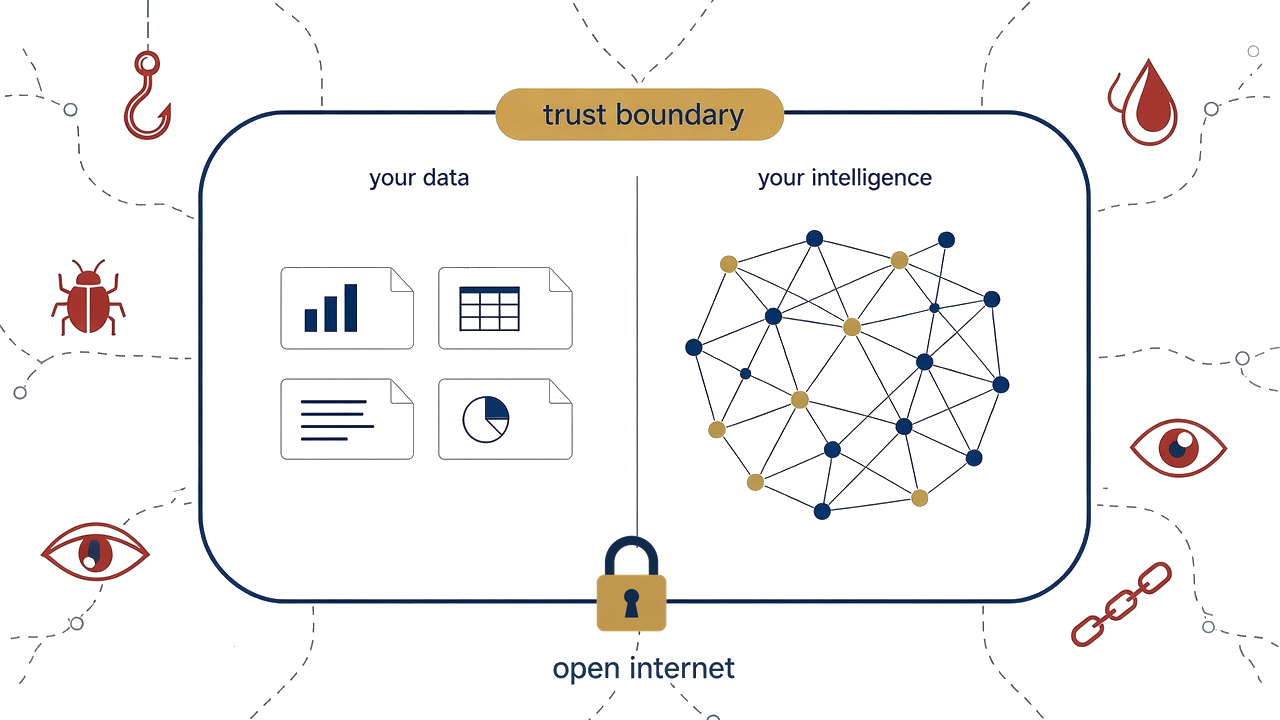
Fields runs inside an environment you control. Prompts, retrieval, and outputs stay on your side of the wall. We design for residency, auditability, and a human in the loop—not for dumping NPI into someone else’s cloud.
Inside
Step 1
Sensitive file
Stays in your systems
Step 2
Fields agent
Runs in your boundary
Step 3
Reviewer + log
Sign-off, then a hash
Outside — not used
Models and agents are built to run inside an environment you control — data center, VPC, or another boundary you hold the keys to.
Sensitive files are not sent to public LLM vendors. If the work cannot be done in-bounds, it does not get done that way.
Material findings wait for a person. Agents draft; a reviewer still owns the call.
What was read, inferred, and approved is recorded. The log stays on your side of the wall.

Founder
Fields is a family name. I’m Zak Fields — and I’ve put that name on this company, so making sure you see value for your money is personal to me. I started as a bank teller, face-to-face with customers across the counter, close enough to feel what Non-Public Information means when it’s a real person in front of me. Learning to program pulled me into the machinery behind that counter: years at Jack Henry & Associates doing bank software conversions, living inside the systems that move money and hold the files. From there I went to Microsoft, working alongside some of the best in the field and mastering the craft of computer science. Then I moved into startups, where I kept advancing the edge of technology — and as part of that, I’ve stayed on the bleeding edge of AI adoption, building it into new products as they take shape.
I’m building Fields Intelligence as a one-person, AI-operated company — to illustrate the power of AI, and to prove how much work you can get done when you build it into everything you do.